

Like many other online sales platforms, Ezynk categorizes products into 2 types: single product & variable product.
Single products are standalone products without variants, and of course, variable products have variants under them.
For example in a fashion store, a bracelet is likely a single product, as it is unlikely to come in say, different sizes. Whereas a product like a t-shirt, it will have variants in different sizes, and possibly colors as well.
If you are new to this concept, then let’s dive deeper. Let’s take a closer at the whey protein example below:
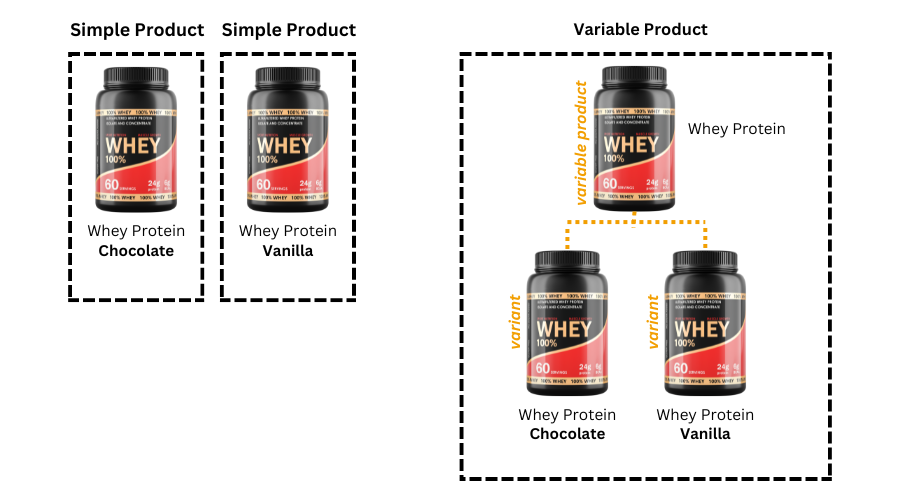
Let’s say we have two products here, whey protein chocolate, and whey protein vanilla. You can choose to create them as two standalone simple products (with no relationship to each other), or you can create them as two product variants under a main variable product.
You think of it as the two products are now being grouped together as one, single variable product: whey protein (without indication of flavors)
The variable product itself acts like a group name, and is NOT an actual product by itself. Thus, the variable product will NOT have any quantity (or is unquantifiable). The variants, on the other hand, will have quantities.
So, why bother grouping these products to create as a variable product? Why not just create two simple products instead?
Though there is no right or wrong way, how you would like to create and manage the products is entirely up to you. However, it is important to note that by using variable product, it can allow for more meaningful report generation, and better user experience (UX).
Report: We are able to view data of variants compounded. For instance, we have 50 units of whey protein chocolate, and 50 units of whey protein vanilla. Thus, because of variable product feature, we are able to view whey protein as a collective product of 100 units altogether.
UX: It’s also a lot easier when updating product info & inventory when we simply first search for the variable product, and then update on its variants. This is especially true for very complicated variable product with a large quantity of variants.
Attributes
Attributes are the differentiating factors of the variants from one another. In the whey protein example, the differentiating factor is flavor. Thus, flavor is defined as the attribute set necessary for whey protein to function as a variable product. And chocolate and vanilla are the values of the flavor attribute set.
Now let’s go back to using t-shirt as an example. A t-shirt comes in two colors: white and black. So both white and black are attributes of this t-shirt product. However, the t-shirt also comes in different sizes as well, with sizes of S, M, L, which also happens to be attributes of the t-shirt.
Since the logical way to buy a shirt, is to pick a size, and then pick a color. Hence, we can say the t-shirt comes in two groups of attribute sets: ‘Size’ & ‘Color’
